Hands-On STEAM Enrichment for Arkansas Homeschool Families: Learning Through Play with Preschool STEAM
By Preschool STEAM · October 24, 2026
Homeschooling gives you the freedom to create learning experiences that fit your child.
But choosing the right enrichment resources can feel overwhelming.
You want your child to explore science, develop problem-solving skills, think creatively, and build confidence. You also want learning to feel engaging and age-appropriate—not like another stack of lessons to complete.
What if some of those important skills could develop through building, experimenting, creating, and playing?
That's where Preschool STEAM comes in.
Why STEAM Belongs in Your Homeschool Day
Young children are naturally curious.
They wonder why things happen, investigate how objects work, build structures, make predictions, and try new ideas.
These everyday experiences are the foundation of STEAM learning.
STEAM stands for Science, Technology, Engineering, Arts, and Math. For young learners, these subjects don't need to be taught separately or introduced through complicated projects.
They can come together naturally through hands-on exploration.
A child building a bridge with blocks is exploring engineering.
A child testing which objects float is investigating science.
A child creating patterns with colorful materials is developing mathematical thinking.
And when something doesn't work the first time? That's an opportunity to problem-solve, redesign, and try again.
Enrichment That Complements Your Homeschool Curriculum
Preschool STEAM isn't designed to replace your homeschool curriculum.
It's designed to enrich it.
Whether your family follows a structured curriculum, a literature-based approach, or a more flexible homeschool routine, hands-on STEAM experiences can give children opportunities to apply what they're learning.
For example, after reading a picture book about spiders, your child might investigate shapes and design a spider web using craft sticks, pipe cleaners, and playdough.
A story becomes an engineering investigation.
Geometry becomes something your child can touch, build, and explore.
And learning extends beyond the pages of a book.
A Simple Approach to Play-Based STEAM
At Preschool STEAM, we use a three-step method to make hands-on learning approachable for parents and educators.
1. Invite Play
Begin with a picture book, an interesting question, or a small collection of materials.
You might ask:
"Can you build something that will hold a pumpkin?"
Then offer blocks, craft sticks, and a small pumpkin.
There's no need to demonstrate exactly what the finished structure should look like.
2. Observe Wonder
Give your child time to explore.
Watch what they build, what they notice, and what they change.
If their structure falls, resist the urge to immediately fix it.
Instead, ask:
"What do you think happened?"
"What could you try next?"
These moments encourage independent thinking and perseverance.
3. Extend STEAM
Follow your child's curiosity into deeper learning.
Could they build a taller structure?
Would a different material work better?
How could they measure their creation?
One simple play experience can lead to investigations across multiple STEAM subjects.
What Makes Preschool STEAM a Good Fit for Homeschool Enrichment?
Designed for Young Learners
Preschool STEAM focuses on developmentally appropriate experiences for children ages 3–6.
Children learn by doing, touching, building, moving, creating, and investigating.
Uses Everyday Materials
You don't need an expensive collection of specialized equipment.
Many experiences use materials such as blocks, cardboard tubes, craft sticks, paper, recycled containers, and natural objects.
Encourages Independent Thinking
Rather than asking children to copy a finished example, Preschool STEAM encourages them to develop and test their own ideas.
Children have room to be creative, make mistakes, and discover different solutions.
Flexible for Your Homeschool Routine
Some families may enjoy a short STEAM invitation after morning reading.
Others may build an entire afternoon around an investigation.
You can adapt experiences to your child's interests, abilities, and attention span.
Makes Planning Easier
You don't have to start from scratch every time you want to introduce a hands-on learning experience.
Preschool STEAM provides ready-to-use ideas, materials lists, guiding questions, and opportunities to extend the learning.
What's Inside the Preschool STEAM Lab?
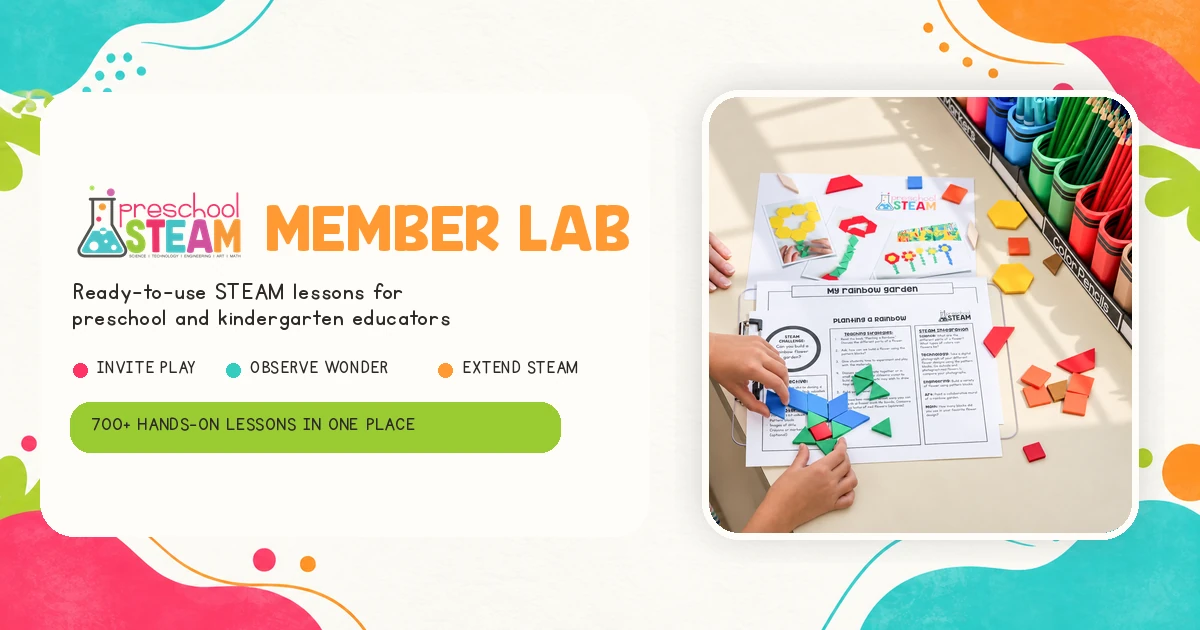
The Preschool STEAM Lab gives families access to a growing collection of playful learning resources, including:
More than 700 hands-on STEAM experiences
12 monthly Play Guides for year-round inspiration
Storytime STEAM activities connecting picture books with hands-on discovery
Simple materials lists and guiding questions
Activities that encourage creativity, curiosity, and problem-solving
You can choose experiences that connect with your current homeschool themes or follow whatever sparks your child's interest.
Studying pumpkins in the fall? Explore measuring, balance, and engineering.
Reading about animals? Investigate habitats and build shelters.
Learning about shapes? Create sculptures, structures, and patterns.
The possibilities grow with your child's curiosity.
Making the Most of Your Arkansas Education Freedom Account
Arkansas's Education Freedom Account (EFA) program helps eligible families access approved educational resources and services.
If you're using an EFA to support your homeschool, you may be looking for enrichment that adds meaningful value to your child's education.
Preschool STEAM offers hands-on learning experiences that can complement your existing curriculum while supporting early science, math, engineering, and creative-thinking skills.
Before purchasing with EFA funds, confirm that the specific Preschool STEAM resource and purchasing method are approved under the current program requirements.
Bring More Wonder Into Your Homeschool
You don't need to be a science expert.
You don't need a dedicated STEAM classroom.
And you don't need to have all the answers.
Sometimes, all it takes is a good picture book, a few simple materials, and a question worth exploring.
Preschool STEAM helps you